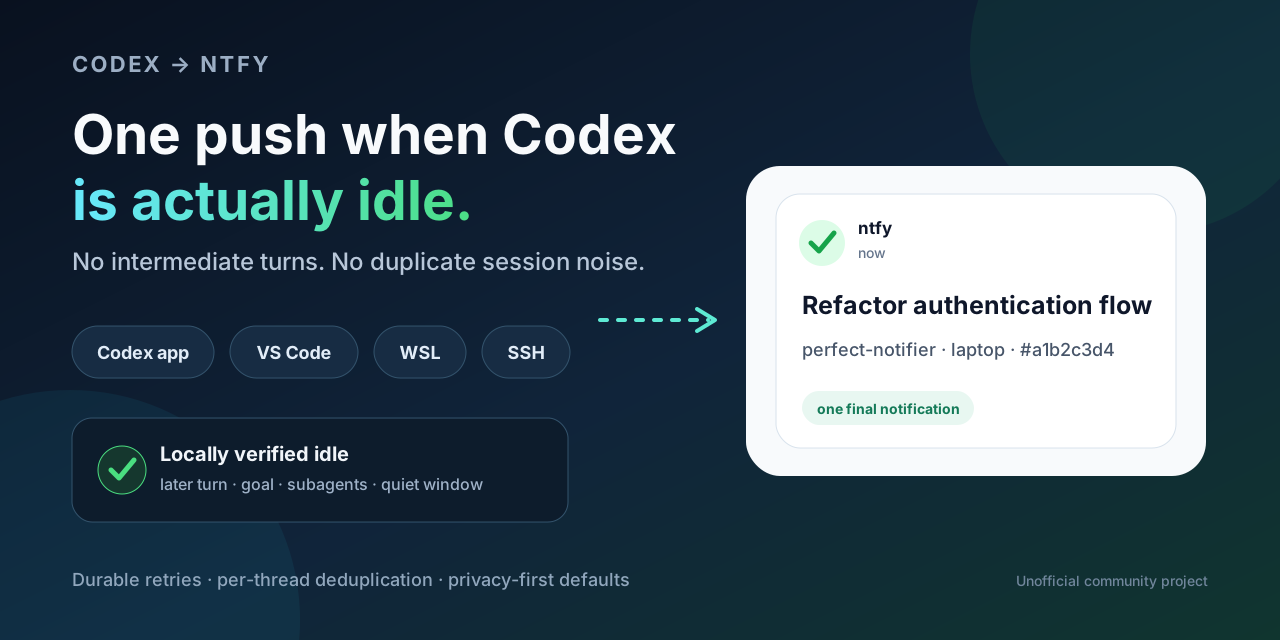
Know when your coding task is actually idle
Codex ntfy Notifier sends an ntfy push after local lifecycle evidence indicates that a root Codex task has no more work. Intermediate turn signals are held behind an idle gate, while a durable outbox retries transient delivery failures.
Version 2.5 also connects local Claude Code on Windows—including Claude
Desktop’s Code tab—through managed lifecycle hooks and a transcript-backed
/goal finality gate, while reusing the same durable queue. A manual goal clear
is discarded rather than announced as a completion.
View the repository · Install the latest release · Quick start
Built for real Codex setups
- Codex app, VS Code extension, and CLI
- opt-in Claude Code on Windows (Desktop Code tab, CLI, and VS Code)
- Windows, WSL2, native Linux, and Remote SSH hosts
- concurrent tasks, automatic continuations, active goals, and delegated agents
- temporary network failures, with a persistent outbox and capped retry backoff
- compact notification titles and privacy-preserving defaults
Each installed environment needs access to its own local Codex lifecycle state. Pure cloud tasks that never mirror that state locally are not guaranteed. The delivery model is durable at-least-once after idle confirmation, not transactional exactly-once.
Quick start
Windows with an optional Ubuntu WSL installation:
git clone https://github.com/ravhello/codex-ntfy-notifier.git
cd codex-ntfy-notifier
.\install.ps1 -WslDistro Ubuntu
Add -EnableClaudeCode to that command to merge the Claude handlers without
replacing existing user hooks.
Native Linux:
git clone https://github.com/ravhello/codex-ntfy-notifier.git
cd codex-ntfy-notifier
CODEX_NTFY_TOPIC=$(python3 -c 'import getpass; print(getpass.getpass("Private ntfy topic: "))')
export CODEX_NTFY_TOPIC
./install-linux.sh
unset CODEX_NTFY_TOPIC
Read the complete installation and privacy guidance
before using a real topic. Newly installed Codex hooks require explicit review
through /hooks.
How it stays quiet and reliable
Completion signals become candidates rather than immediate notifications. The idle gate checks the matching turn, later work, goal state, active descendants, and a short quiet window. Eligible events then move atomically into a host-local outbox, where one worker retries transient failures and deduplicates stable thread-and-turn identities.
Architecture · Privacy and security · Troubleshooting · Contributing
This is an unofficial community project. It is not affiliated with or endorsed by OpenAI, Anthropic, or ntfy.